JUST IN: The heat wave moves to eastern Europe: Germany and Switzerland once again break temperature records
World News Update:
The following report highlights an important international development currently attracting worldwide attention.
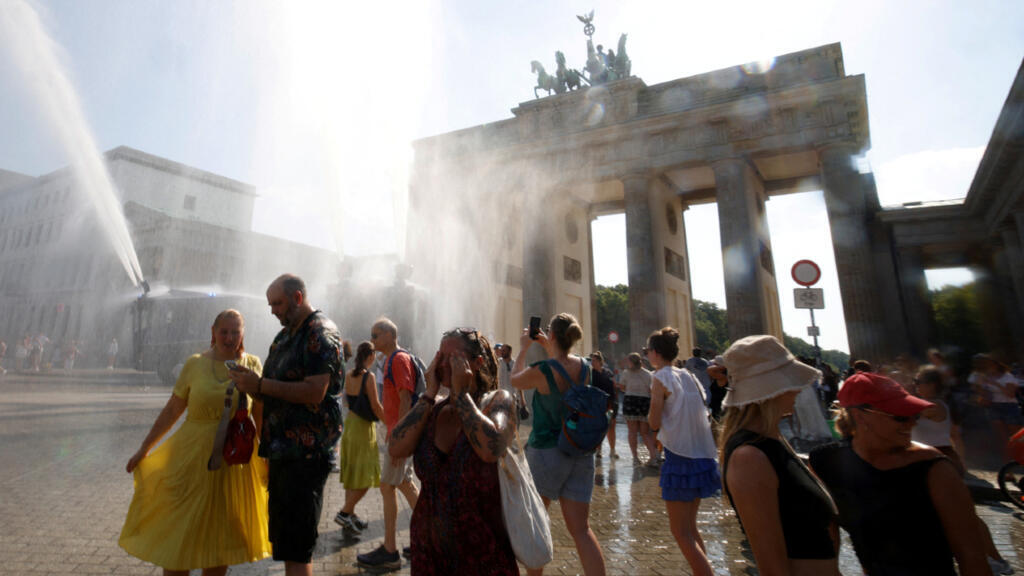
The historic heat wave that wreaked havoc in Western Europe, with unprecedented temperatures for the month of June in France and the United Kingdom, is moving towards eastern Europe, suffocating countries that also break records in their mercuries. This is the case of Germany. This Saturday, June 27, the Drewitz weather station (east of the country) detected a peak of 41.5 ºC around 4:30 p.m. (local time), according to preliminary data from the German Meteorological Service (DWD), surpassing the record of 41.3 ºC established on Friday in Saarbrücken, in the southwest of the territory. Switzerland, for its part, recorded its third consecutive day of registrations for June. MeteoSwiss recorded, around 1:30 p.m. (local time), 39º on the thermometers of the Basel/Binningen meteorological station, breaking the previous record of 38.8 ºC, in the same place. A screen in Berlin, June 26, 2026, displays cautionary messages due to the heat wave hitting Germany. © Tobias Schwarz / AFP Furthermore, the Czech Republic and Denmark reached the highest historical temperatures since records began. The Czech Meteorological Service (CHMI) recorded 40.6ºC in Doksany, north of Prague, surpassing the 40.4ºC in Dobrichovice, in August 2012. Meanwhile, the Danish Meteorological Institute announced a peak of 37ºC in Odum, north of Aarhus, shortly after reporting a record of 36.6ºC north of Odense, making Saturday the 27th of June in “the hottest day ever computed since records began in 1874.” Read alsoParis postpones its Pride March due to the heat wave in Europe, “impossible” without the climate crisis A sweltering weekend in Germany “The heat wave will reach its peak this weekend, with temperatures above 40 degrees in some areas of Germany,” declared Karsten Brandt, meteorologist at the weather forecast portal Donnerwetter.de. As a result of the heat, the organizers of the Ironman European long-distance triathlon championship, which takes place this Sunday in Frankfurt, have shortened the cycling and running courses. Faced with the possibility of infrastructure damage, such as road collapses and train track swelling, some major utility providers have attempted to reduce traffic. A man rides a bicycle through a fountain on the outskirts of the financial district in the center of Frankfurt am Main, western Germany, on June 26, 2026. © Kirill Kudryavtsev / AFP Likewise, the German national railway company Deutsche Bahn has offered its customers the option to cancel long-distance travel reservations free of charge until early next week. The company says its infrastructure is under considerable strain due to exposure to the sun and the additional risk to signals, roads and power lines from storms and wildfires. Some areas of Germany, mainly in the south-west, have already experienced a much warmer-than-usual June, although the most intense heat is expected to begin to subside this weekend, with strong storms expected towards the end of Sunday. Read alsoFrom Spain to Germany, Europe suffers a heat wave that affects more than 100 million people The heat wave subsides, but its effects will continue for “several days” in France In France, dozens of people, both young and old, died during the heat wave. Since June 18, authorities have recorded 74 deaths due to drowning, according to Interior Minister Laurent Nuñez in an interview with Le Parisien. These deaths occurred “mainly in unauthorized and unsupervised bodies of water: rivers, streams and ponds, in particular,” he explained, adding that there were also “drownings in private pools.” “There is a phenomenon of sudden immersion in cold water, sometimes due to overexertion. We are seeing many deaths from heart attacks,” he added. The thermometer of a pharmacy in Thionville, in the northeast of France, shows a temperature of 39 degrees Celsius, on June 26, 2026 © Jean-Christophe Verhaegen / AFP The severity of the consequences means that the two funeral homes in Paris, located in Batignolles and Ménilmontant, “have no more available capacity” since Saturday morning and are “redirecting attention to the nearby suburbs”, as he told the AFP agency Elisabeth Charrier, general delegate of the National Federation of Funeral Homes. Similarly, the AP-HP, the management network of public hospitals in the French capital, indicated that care in emergency services remained exceptionally high for the second consecutive day, with nearly 3,000 visits in 24 hours, a level 36% higher than that of a regular day. For this reason, the office of Prime Minister Sébastien Lecornu warned that “although the heat wave is subsiding, its effects on the pressure on the health system persist” and “will remain at a high level for several days” due to cases of “dehydration, decompensation, delays in hospitalizations.” Read also “I try to resist”: this is how Paris workers face the extreme heat wave in France Temperatures above 40 ° C have interrupted rail transport and energy generation, caused the ban on outdoor alcohol, the closure of schools and the postponement of outdoor events. For this Sunday, Météo-France announced that 24 departments in the country will remain on red alert and another 41 will be under code orange. The heat wave moves to central Europe and the Balkans Across Europe, large cultural monuments have had to close, agriculture has been affected and some hospitals have had difficulty coping with the situation. According to the Reuters Climate Monitor, the heatwave has raised temperatures up to 18°C above their seasonal average, and is being driven by a phenomenon known as Omega blocking. This weather pattern traps a mass of warm air over regions for long periods, with colder air at its margins. Map showing maximum temperatures at two meters above ground level recorded on 24 June 2026 in Europe, based on MARSMet data from the European Drought Observatory (EDO). Cartographic data: NASA, Jaxa, Gebco, OSM. © Sylvie Husson, Sabrina Blanchard, Sabrina Blanchard / AFP Demand for electric fans has soared and Asian air conditioning manufacturers have reported a boom in sales in Europe. This is in addition to the fact that most homes in northern Europe are not built to mitigate heat, but to retain it. The current phenomenon of extreme temperatures, the first of several that are predicted for this European summer, will begin to move at the end of the month, affecting Central Europe and the Balkans, according to the World Meteorological Organization. A study by the World Weather Attribution group of scientists concluded Friday that the heat wave would have been “virtually impossible” without human-caused climate change, making nighttime temperatures this week 100 times more likely than just two decades ago. Read alsoFrance, United Kingdom, Spain…Europe faces a historic heat wave that leaves victims and temperature records With Reuters and AFP
Key Developments:
Analysts believe this development may influence future diplomatic, political, or economic discussions internationally.
Observers believe further developments could significantly shape the direction of this story in the near future.
Stay tuned for further updates on this developing international story.
Source: This article was originally published by France 24 – Noticias y actualidad internacional en vivo and adapted for our international English-speaking audience.
Read the original article here.