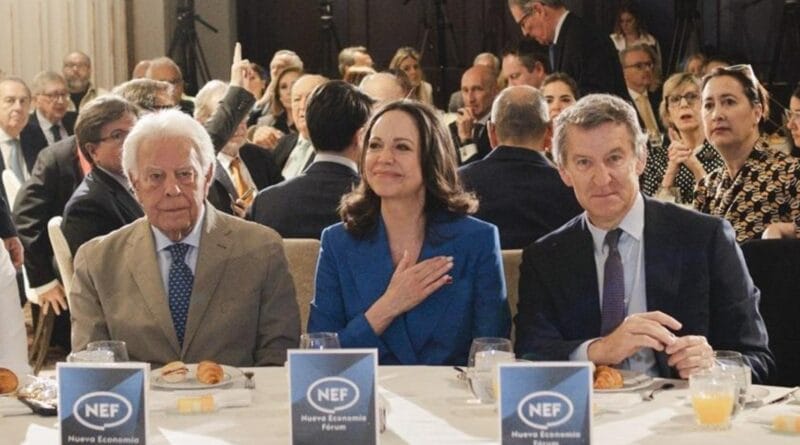
BREAKING: The teams of María Corina and Marco Rubio will negotiate in Chicago the dates and phases of the transition in Venezuela
New information reveals that the following story has emerged from the international scene.
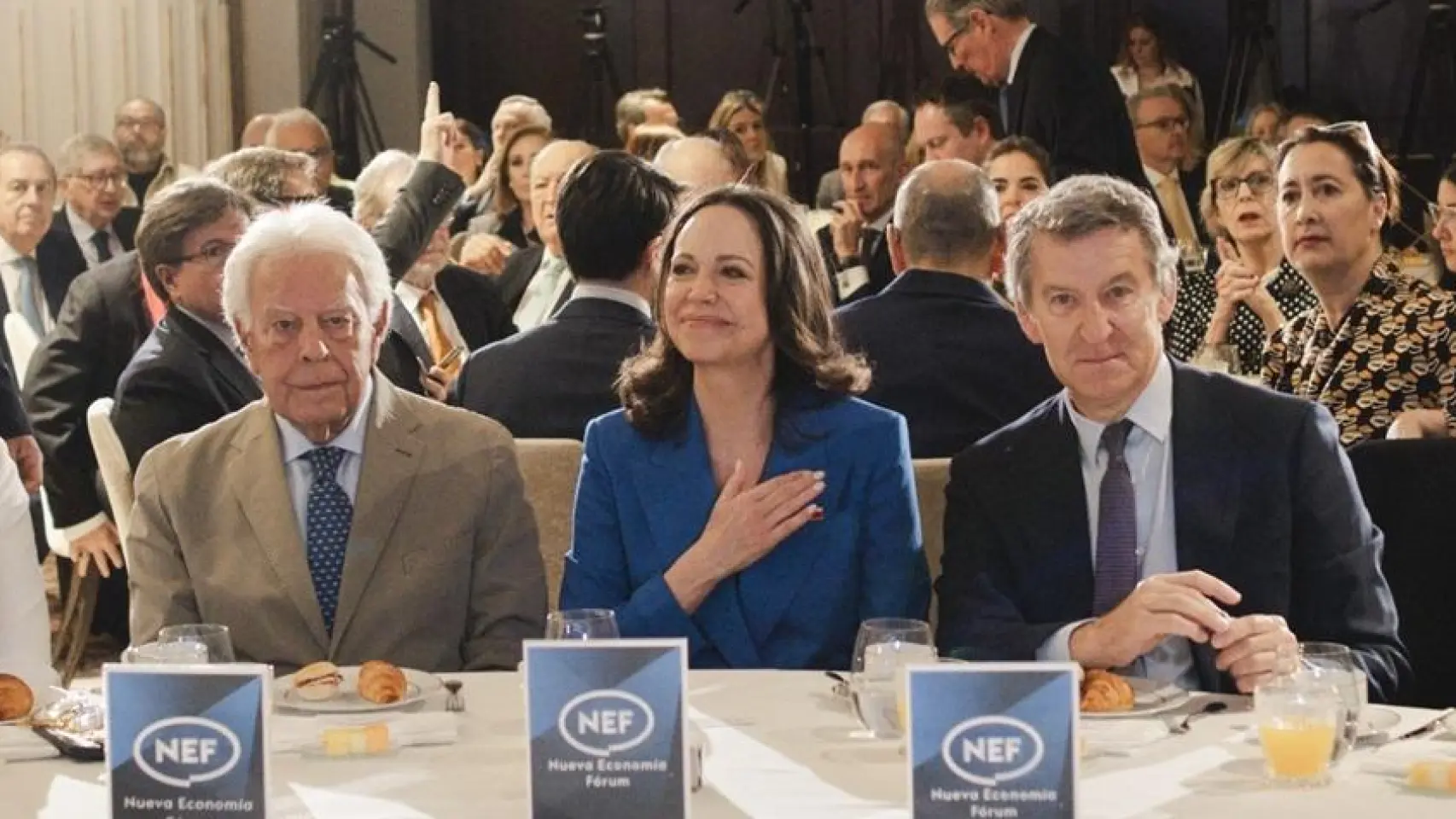
María Corina Machado, democratic leader of the Venezuelan opposition, left Madrid this Monday with a roadmap for the democratic transition in Venezuela in hand. His team has already begun working on it with Marco Rubio, US Secretary of State. The democratic transition in Venezuela has its phases, its protagonists and the start date of the effective process, after the capture of Nicolás Maduro, on January 3 in a military intervention ordered by Donald Trump. According to the information that EL ESPAÑOL has had access to, through various sources involved, representatives of the Venezuelan opposition and a delegation of US officials headed by Rubio have begun formal meetings in Chicago. The meetings are held in one of the offices of the Drug Enforcement Administration (DEA) in that city in the state of Illinois. This is one of the agency’s main regional offices. The DEA has for years been the main repository of complaints that the opposition, in addition to repentant or captured Chavistas, have filed against leaders of the Maduro regime for drug trafficking, money laundering and organized crime. That it is now not only the one handling the accusations against the captured tyrant before the New York court, but also the umbrella under which the transition is negotiated says a lot about the nature of the coming process. The negotiating team is made up of 12 people—three women and nine men—distributed into three work groups with specific functions: Control, Finance, and Political and Social Action. Each table has a designated person in charge. The objective is to lay the foundations for an eventual negotiation with the Chavismo sector ready for an agreed solution that culminates in a controlled and peaceful transition, supervised at all times by the Trump Administration. Those responsible The Finance table will be led, according to sources, by Machado herself, the last Nobel Peace Prize winner and the most prominent figure in the fight for Venezuelan democracy in the last two decades. The Control Board is in the hands of Ismael García, the historic unionist who started in Chavismo and has been working in the shadows for democratic change for years. His were the first complaints to the DEA against ‘Pollo’ Carvajal and Cilia Flores, wife of Nicolás Maduro. The Political and Social Action group is headed by a senior American official, whose identity has not yet been revealed. The three tables will not work in parallel, but in a coordinated manner. The process is expected to also include meetings with financial entities and large companies, which points to both an institutional and economic strategy to guarantee the country’s stability during the process of change. There is also an issue of enormous political sensitivity on the table: the possibility of a partial amnesty for certain actors in the regime in exchange for their collaboration in the transition. It is the most controversial point of the process and the one that generates the most resistance within the opposition itself. Machado, more than an icon María Corina Machado, 56, is the most recognized leader of the Venezuelan opposition, but she is not only an icon elevated by her resistance and audacity. Founder of the NGO Súmate and the political platform Vente Venezuela, she has been detained, harassed and physically beaten by agents of the regime. In 2014 she was illegally stripped of her seat in the National Assembly. In 2024 she was arbitrarily disqualified from running in the presidential elections on July 28. Despite this, he organized from clandestinity the most powerful electoral campaign that Venezuela has known in decades. The ban on candidacy forced the opposition to look for a replacement. They found it in the former diplomat Edmundo González Urrutia, who won the elections according to the official records, collected and published by the opposition itself. The regime denied victory and unleashed repression. González took refuge first in the Netherlands embassy and then in the residence of the Spanish ambassador in Caracas, where he was pressured by brothers Jorge and Delcy Rodríguez in a meeting that was recorded. There he signed a resignation document “under extortion,” as he himself later declared. And he left Venezuela with a safe conduct. Since September 2024, he has lived in exile in Madrid. From the original Podemos to the struggle Ismael García, today also exiled in Spain, represents one of the most unique profiles of this process. A grassroots unionist formed in Cuba in the 1970s, he was a founding member of the Movement towards Socialism (MAS) and mayor in the state of Aragua in the 1990s. “He was one of the most famous and prominent supporters of Hugo Chávez, at the beginning of the revolution,” explains a direct source. Then, he was a parliamentary ally of Chávez. But he became its most incisive critic of its authoritarian drift, rejecting support for the Colombian narco-guerrillas of the FARC and the ELN, and expressed it publicly by rejecting the imposition of the United Socialist Party as a single party. In 2007, he was one of the few deputies who voted against the Chavista constitutional reform. Despite sharing leftist ideology with Chávez, he repudiated his autocratic and totalitarian tendency. Chávez publicly called him a “traitor.” Since then, he has spent almost two decades building, from within and from exile, the files and networks that today are the legal and operational skeleton of the transition. His knowledge of the system—he knows how Chavista power works because he lived it from the inside—is precisely what makes him an irreplaceable piece at the Control table. As Machado herself explained in a recent interview with this newspaper, “she knows the monster inside.” García is not just a politician: he is the man who for years brought evidence before the North American Justice Department against figures like Diosdado Cabello and against the former head of military intelligence Hugo ‘el Pollo’ Carvajal, whose arrest at the request of the US he himself anticipated. Blanco, Machado’s advisor in the US Carlos Blanco acts as an articulator between the three working groups and has the trust of both Machado and García and Rubio. Economist and former Minister for State Reform during the second government of Carlos Andrés Pérez, he was the architect of Venezuelan decentralization in the 90s, prior to Chavismo. He has been exiled in Boston for decades, where he is a professor at Boston University and one of Machado’s closest strategic advisors. “He is a fundamental figure, practically Machado’s ideologue,” details another close source. “They offered him hundreds of millions of dollars not to join the democratic opposition,” this source continues, “and that principled resignation has made him highly respected.” He also knows the regime from within, “understands the regime and has a lot of information about the beginning of Chavismo.” His proposal for the transition is that it should be orderly, quick and with legitimate authority. Not a chaotic rupture, but an institutional reconstruction that begins with the freedom of political prisoners and the calling of free elections. Hence the parallels that have been drawn with the Spanish Transition of the 70s. This approach is shared by Omar González, another of Machado’s strong men in this working group: dismantle the current power without a chaotic rupture, create credible transition authorities, release “immediately all political prisoners” and accompany the process with a parallel institutional and economic reconstruction. Rubio, the pilot from Washington The man who pilots all this from Washington is Marco Rubio. The Secretary of State acts under the direct mandate of Donald Trump, who already in his first presidency (2017-2021) maintained direct contact with María Corina Machado’s team. The US president even openly raised the possibility of military intervention in the country. Machado herself recognized this in an interview given to this journalist almost a decade ago, in which she also criticized the mediation of José Luis Rodríguez Zapatero. Already then she described the influence of the former Spanish president as “disastrous”, in a process that, according to her, had resulted in “30,000 deaths and 600 political prisoners.” The numbers are multiplying today. Now, with Maduro captured on January 3, 2026 by the Delta Force in Fort Tiuna, and in the hands of the US Federal Justice, the window that was then left in cracks has completely opened. A more than predictable conviction of Maduro for drug trafficking would make him the first sitting president convicted of that crime in history. And it would mark the point of no return. In fact, the suspension of the sentence of Pollo Carvajal, the former director of the Directorate of Military Intelligence of Venezuela (DIM), this very last week, would confirm that the pieces of the board are in place. The Venezuelan transition is not closed. But for the first time in decades, there are architects, it has defined phases and, above all, the support of the most powerful man in the world. After meeting with Alberto Núñez Feijóo and Santiago Abascal, and after being honored by the City Council and the Community of Madrid, one unknown remains: the deep reasons why Machado has not met these days with Pedro Sánchez, president of the Spanish Government. While it feels very close to the socialist Felipe González, the Venezuelan opposition is suspicious of the socialist leader, whose position on Venezuela, through the figure of Zapatero, the “friend of Delcy and Jorge Rodríguez”, has shifted to positions, at least, less belligerent with Chavismo.
Editor’s Insight:
Understanding these events is crucial for anyone following international affairs closely.
World leaders are expected to respond to these developments in the coming days.
We encourage our readers to follow this developing story for the latest information.
Source: This article was originally published in another language by El Español – Home and has been translated and adapted for our global English-speaking audience. Read the original article here.