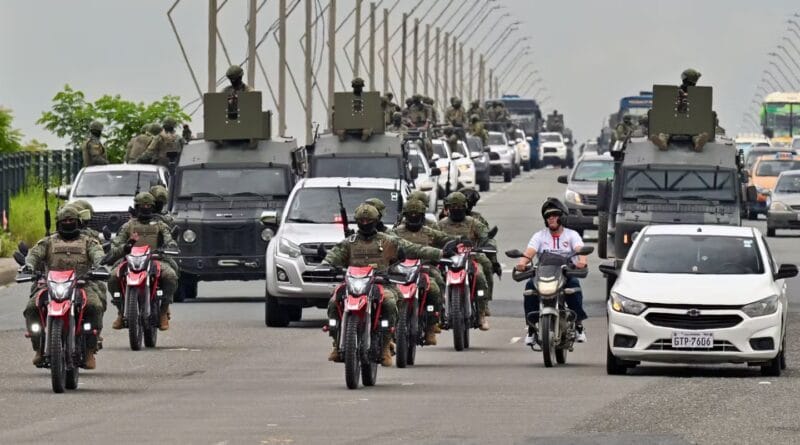
Curfews, military action, and U.S. collaboration mark a two-week offensive against drug cartels and rising violence.
Ecuador has initiated a two-week crackdown on drug trafficking, with strict curfews and a large military deployment aimed at combating rising violence and organized crime in the country. This operation, launched on the evening of Sunday, March 15, 2026, is backed by the United States and targets areas most affected by the growing power of drug cartels. The crackdown comes as Ecuador continues to grapple with a surge in homicides, disappearances, and other crimes linked to the cocaine trade.
A Strong Offensive Against Cartels
Ecuadorian authorities have rolled out a “very strong offensive” in several coastal provinces, with the backing of U.S. forces. Interior Minister John Reimberg announced that between March 15 and March 31, regions such as Guayas, Los Rios, Santo Domingo de los Tsachilas, and El Oro will be under strict curfews from 11 p.m. to 5 a.m. local time. During these hours, only emergency personnel, health workers, and travelers with plane tickets will be allowed to move freely. The aim is to restore order in areas plagued by cartel violence.
“Stay at home… it is for your own safety,” Minister Reimberg urged citizens, warning of the consequences if the curfew was not respected. This measure is reminiscent of the lockdowns during the Covid-19 pandemic, with checkpoints manned by the military ensuring compliance.
“Stay at home… it is for your own safety so that we do not have any consequences that we do not want,” Interior Minister John Reimberg said during his announcement of the curfew.
A Show of Force
In response to the escalating violence, Ecuador has deployed 75,000 heavily armed soldiers, accompanied by convoys of armored vehicles, motorcycles, and helicopters. The operation is part of the country’s ongoing effort to curb drug-related violence and organized crime, which has spiraled in recent years due to fierce competition among criminal groups. While details of the operation remain sparse, the government has not disclosed whether American troops will be involved, though U.S. military presence has already been reported in the country under President Daniel Noboa’s leadership.
Ecuador is a key player in the regional fight against drug trafficking and is part of an alliance of 17 countries formed earlier this month at a summit in Miami, dubbed “Shield of the Americas.” The initiative, supported by U.S. President Donald Trump, is aimed at combating drug cartels and the flow of cocaine through Latin America.
Ecuador’s strategic location, situated between Colombia and Peru—the world’s largest cocaine producers—has made it a crucial transit point for the drug trade. An estimated 70% of the cocaine produced in these neighboring countries passes through Ecuador to be exported via its Pacific ports. This has contributed to the surge in violent crime in Ecuador, with organized crime groups, including Mexican cartels, vying for control of the drug market.
Record Homicide Rates
The surge in cartel activity has led to a sharp increase in violent deaths. In 2025, Ecuador saw a record 9,216 homicides, with a homicide rate nearing 52 per 100,000 inhabitants, according to the Organized Crime Observatory. This violent trend has plagued the nation for years, with many Ecuadorians frustrated by the government’s inability to contain the spread of cartel influence.
Despite President Noboa’s two-year war on drug cartels, the country’s homicide rates continue to climb, underscoring the complex challenge Ecuador faces in curbing the reach of transnational organized crime. While the government is intensifying efforts, the effectiveness of the two-week military offensive remains uncertain, as does the long-term impact of U.S. support in the region.