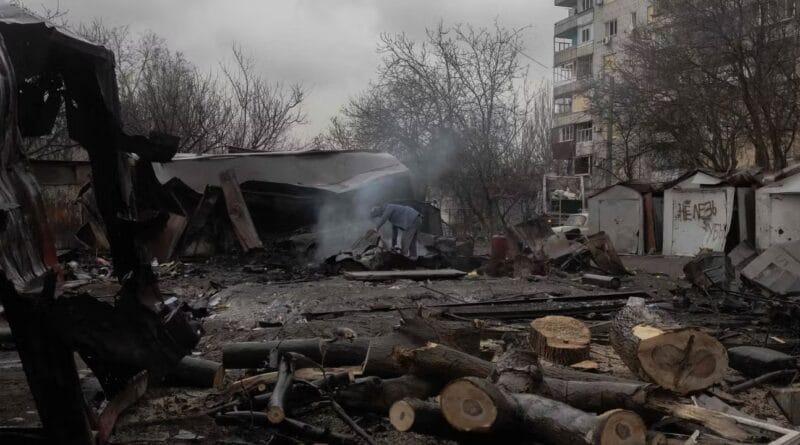
LATEST: North Korean troops, Iranian drones and Chinese economic support allow Moscow to continue conflict, Pentagon says
North Korean Troops, Iranian Drones, and Chinese Economic Support Helping Moscow’s War in Ukraine, Pentagon Warns
US Military Officials Discuss Growing Threats Amid Ongoing Ukraine Conflict
Washington D.C. — In a sobering assessment of the international situation, US military officials have highlighted the critical role that North Korean troops, Iranian drones, and Chinese economic support are playing in enabling Russia to continue its war in Ukraine. The Pentagon’s latest statements suggest a complex web of international cooperation that sustains Moscow’s military efforts despite significant losses on the battlefield.
US Diplomacy Focused on Achieving a Lasting Peace
During a hearing before the House Armed Services Committee, Daniel Zimmerman, the Assistant Secretary of Defense for International Security Affairs, provided an update on the administration’s efforts to broker peace in Ukraine. Zimmerman emphasized that the Trump administration is actively engaging in negotiations with both Russia and Ukraine, aiming to secure a lasting peace based on credible security guarantees for Ukraine.
“This approach starts with a strong Ukraine and a strong Europe,” Zimmerman stated, underscoring the necessity of bolstering Ukraine’s defense capabilities and ensuring the strength of European allies.
Zimmerman also noted the significant contributions from European countries, with more than twenty nations pledging over $4 billion as part of the Prioritized Ukraine Requirements List (PURL) initiative. These funds are aimed at supporting Ukraine’s military needs as it faces off against Russian forces.
Russia’s Resilience and Nuclear Capabilities
Despite the support from NATO and its allies, Zimmerman warned that Russia remains a formidable adversary, with substantial military and industrial reserves. He pointed to Moscow’s large and diverse nuclear arsenal as a critical factor in the ongoing conflict, emphasizing that Russia is developing additional capabilities that could be used to exert coercive pressure without crossing the line into a full-scale nuclear confrontation.
“Russia retains significant reserves of military and industrial power,” Zimmerman noted, reiterating the importance of continued vigilance against Moscow’s growing capabilities.
North Korea, Iran, and China: A Dangerous Alliance for Moscow
In his testimony, General Alexus Grynkewich, the Supreme Allied Commander in Europe at NATO, painted a picture of a “complex and evolving” global security environment. He highlighted the growing cooperation between Russia, North Korea, Iran, and China as a dangerous factor in the ongoing conflict.
According to Grynkewich, these nations are playing a pivotal role in strengthening Russia’s military position:
- North Korean troops are contributing to Russia’s efforts on the ground in Ukraine.
- Iranian drone technology is bolstering Russia’s capacity to strike at Ukrainian infrastructure and military targets.
- Chinese economic support is helping Russia maintain its war efforts despite international sanctions.
“These countries are increasing military risks in several theaters,” Grynkewich warned. “North Korean troops, Iranian drone technology, and Chinese economic support allow Moscow to continue its war in Ukraine.”
Despite the heavy toll on Russian forces, Grynkewich stressed that Moscow still possesses the ability to threaten US interests through its expansive nuclear arsenal and asymmetric capabilities, which span across land, air, and sea forces.
NATO’s Strategic Challenges: Ensuring Long-Term Burden Sharing
While reaffirming US support for NATO, Zimmerman also cautioned that unbalanced or insufficient burden-sharing within the alliance could undermine its long-term effectiveness. He urged NATO members to step up their contributions to ensure the security of Europe and the broader alliance.
“Unbalanced or insufficient burden-sharing is not healthy for the Alliance,” Zimmerman remarked, calling for NATO to be strengthened in the long term.
Both Zimmerman and Grynkewich expressed concerns over the growing military and economic alliance between Russia, North Korea, Iran, and China, which is shaping the broader global security landscape. The evolving threat posed by these countries continues to complicate efforts for a peaceful resolution in Ukraine, with NATO and the US facing heightened strategic challenges on multiple fronts.
Related Keywords: North Korea, Iran, China, Russia, Ukraine War, NATO, Pentagon, Trump Administration, Daniel Zimmerman, Alexus Grynkewich, Military Support, Nuclear Threat, Global Security.
Analysis and Perspective:
This development could have far-reaching consequences for global politics in the months ahead.
As the situation continues to evolve, analysts are closely watching for further developments.
Stay tuned for more updates as this story continues to unfold.
Source: This article was originally published in another language by International : Toute l’actualité sur Le Monde.fr. and has been translated and adapted for our global English-speaking audience. Read the original article here.