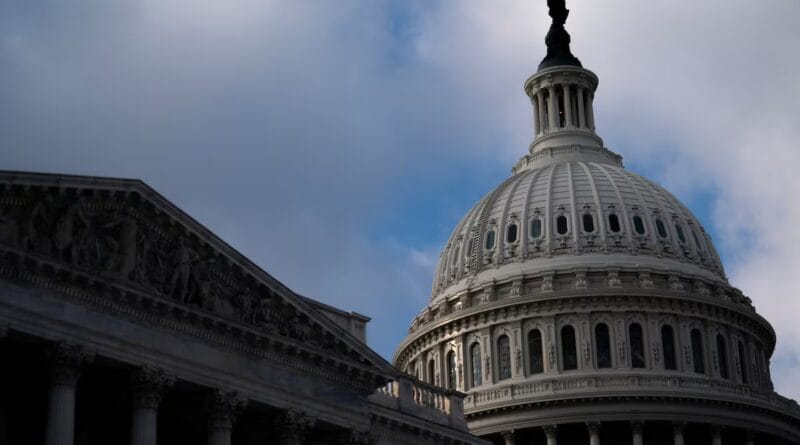
JUST IN: Senate seeks to end month-long partial government shutdown with vote to fund Department of Homeland Security
New information reveals that the following story has emerged from the international scene.
The United States Senate voted this Friday morning to fund most of the Department of Homeland Security (DHS), whose resources had run out in mid-February after Democratic lawmakers demanded limits on immigration enforcement agencies as a condition for approving new funding.
The measure approved by the Senate does not include funds for Immigration and Customs Enforcement (ICE) or the Border Patrol. However, it does provide funding to pay airport security personnel, who have gone more than a month without pay due to the partial government shutdown—causing long lines and disruptions at airports across the country.
The bill must now be considered by the House of Representatives, which could vote on it as early as Friday. Its fate there remains uncertain, as several Republicans from the party’s more conservative wing oppose leaving immigration agencies unfunded as part of a compromise with Democrats.
Still, President Donald Trump may pressure members of his party to approve the measure and bring an end to the longest partial government shutdown in U.S. history.
Just hours before the Senate vote, Trump announced that he would sign an executive order instructing the new Secretary of Homeland Security, Markwayne Mullin, to ensure payment for Transportation Security Administration (TSA) workers, who missed yet another paycheck on Friday.
In a message posted on his social network Truth Social, Trump sharply criticized Democrats and Senate Minority Leader Chuck Schumer, accusing them of siding with undocumented immigrants over American citizens. He argued that Democrats were refusing to fund immigration enforcement unless Republicans accepted what he described as “open border policies.”
Trump justified his executive action by stating that Democrats had created a “national crisis,” and that he was using his legal authority to protect the country by ensuring TSA workers were paid.
The situation at airports has worsened significantly. More than 450 TSA officers have resigned in recent weeks, and thousands have missed shifts due to financial strain. These absences have caused severe staffing shortages and what officials describe as the longest wait times in TSA history.
Earlier in the week, the administration deployed hundreds of ICE agents to airports in an attempt to alleviate pressure on TSA personnel.
At the center of the political standoff are ICE and Border Patrol. Democrats have refused to approve full DHS funding without reforms to these agencies following the fatal shootings of two American citizens, Renée Good and Alex Pretti, in Minneapolis in January—incidents that sparked nationwide protests.
Since DHS funding expired on February 14, Democrats have maintained their demands despite growing disruptions. Among their proposals: banning agents from covering their faces, requiring body cameras, and limiting arrests to cases with judicial warrants.
Republicans have largely rejected these conditions, particularly those restricting enforcement powers.
The bill passed by the Senate represents a compromise in which neither side fully achieved its goals. It resembles earlier Democratic proposals that Republicans had previously blocked for failing to fully fund DHS.
While it does not impose the level of oversight Democrats sought for ICE, Senate Minority Leader Chuck Schumer welcomed its passage. He emphasized that Democrats would not support unrestricted funding for immigration enforcement agencies without meaningful reforms, especially in light of the Minneapolis killings.
Schumer added that Democrats would continue pushing for changes to ensure accountability within ICE and Border Patrol moving forward.
What This Means:
This development could have far-reaching consequences for global politics in the months ahead.
This is part of a broader trend that has been reshaping the geopolitical landscape in recent months.
We encourage our readers to follow this developing story for the latest information.
Source: This article was originally published in another language by Internacional en EL PAÍS and has been translated and adapted for our global English-speaking audience. Read the original article here.