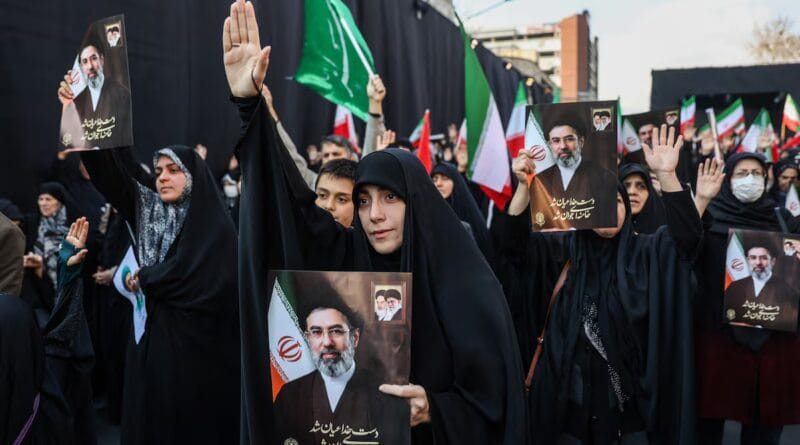
ALERT: Mojtaba Khamenei begins a leadership in Iran threatened with death and without hope for change | International
The appointment of Ali Khamenei’s son raises concerns both domestically and internationally over his ability to lead a divided Iran.
On Sunday, Mojtaba Khamenei was officially named Iran’s new Supreme Leader, following the death of his father, Ali Khamenei, under mysterious circumstances in February. While many expected this moment, the succession of the younger Khamenei has sparked controversy both in Iran and abroad. The 56-year-old, who has long been seen as the heir apparent to the Islamic Republic’s highest office, now faces an uphill battle to consolidate power, with critics questioning his legitimacy and his capacity to manage an increasingly fractious nation.
A Family Dynasty of Power
Mojtaba Khamenei’s rise to the top has been in the making for decades. As early as 2005, during the presidential election that saw Mahmoud Ahmadinejad’s controversial victory, Mehdi Karrubí, a moderate cleric and rival candidate, wrote a letter to the then-supreme leader, Ali Khamenei, accusing his second son, Mojtaba, of interfering in the political process. At that time, Karrubí dubbed the younger Khamenei “Aghazadeh,” a term meaning “son of the lord,” which denoted a person of privilege. Ali Khamenei, however, responded cryptically, referring to his son not as an “Aghazadeh” but as “Agha”—a term of reverence traditionally reserved for the supreme leader himself.
From that moment, Mojtaba’s path was clearly set. As an influential figure within the Revolutionary Guard—a powerful military faction that, alongside the Supreme Leader’s office, wields considerable control in Iran—Mojtaba’s candidacy was always likely. His role in orchestrating electoral fraud in 2005 to help Ahmadinejad clinch the presidency only solidified his standing among the regime’s hardline factions. “Mojtaba Khamenei has been the candidate for supreme leader of the Revolutionary Guard ever since then,” said international security analyst Shahin Modarres.
“He represents the Revolutionary Guard and the oligarchs… he will be a puppet of that force,” Modarres predicted, casting doubt on Khamenei Jr.’s ability to navigate the complexities of leadership.
A Divided Iran Faces a Perilous Future
Though Khamenei Jr. has been anointed as the leader, his legitimacy remains in question, both among Iranians and international observers. Critics point to his lack of political and clerical experience, as well as his relative obscurity on the public stage, as potential stumbling blocks for his leadership. Mojtaba’s rise has been seen by some as a sign of dynastic rule, not a meritocratic transition of power. The lack of a clear record or notable political achievements leaves many questioning his ability to address the country’s mounting crises.
Reformists within Iran, long hopeful for an easing of the Islamic Republic’s authoritarian grip, had hoped for a more moderate successor, someone who might navigate a difficult future for Iran. But with Mojtaba’s appointment, that hope has evaporated. “At least we could have had a more conciliatory person,” lamented Majid, an Iranian from the diaspora. His disappointment echoes the sentiments of many who feel trapped in an unyielding system.
Internationally, the appointment has raised alarms. Israel, which has already threatened military action against the regime, has made it clear that it views Mojtaba’s succession as a threat. The United States, under former president Donald Trump, also warned that the new leader’s reign would be short-lived unless he earned their approval. “If he doesn’t have his approval, he won’t last long,” Trump had remarked shortly before the announcement.
“This is a deeply ideological vision, more focused on war than on diplomacy,” said Meir Javdanfar, a professor of Iranian politics, describing the outlook of Mojtaba Khamenei’s leadership.
The Global Impact of Iran’s New Leadership
Mojtaba’s appointment has not only upset many Iranians but also rattled global markets. Following the announcement, oil prices surged by 20%, reaching $114 per barrel, the highest level since 2022. The global community is watching closely, particularly Israel and the United States, who see the Khamenei family as an enduring adversary. Yet, for some analysts, this represents a failure for the West. “If Israel finally accepts that the regime won’t change, then it will have failed,” said Javdanfar.
For now, Mojtaba Khamenei faces an uphill battle to secure his power domestically. His success in quelling internal divisions will be key to determining whether he can lead Iran through a turbulent period marked by protests, economic instability, and international isolation. The regime may have hoped for a smooth transition, but with mounting doubts and continued unrest, the future of the Islamic Republic appears uncertain.
As one Iranian student from Tehran, Nahid, remarked: “You couldn’t expect anything else. Since the Revolution, their slogans have been ‘war, war until victory,’ and it seems the fate of the country doesn’t matter to them.”
Analysis and Perspective:
Experts suggest this event marks a turning point that may influence policy decisions worldwide.
The implications of this story extend beyond borders and could affect millions of people globally.
Follow our coverage for real-time updates on this and other major global stories.
Source: This article was originally published in another language by Internacional en EL PAÍS and has been translated and adapted for our global English-speaking audience. Read the original article here.