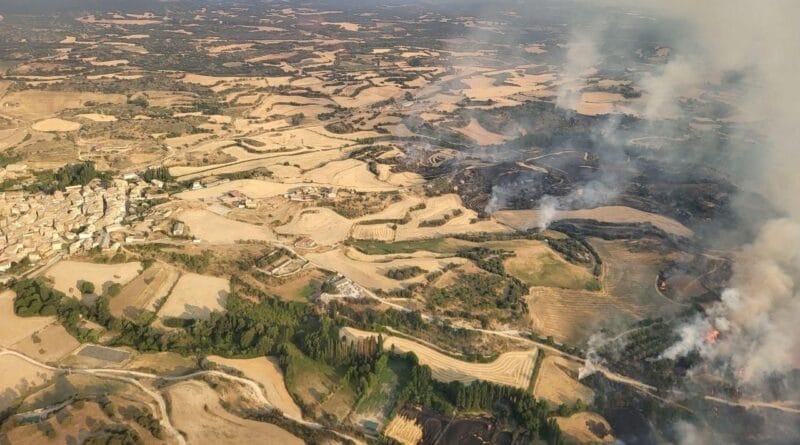
UPDATE: It has devastated more than a sixth of the 75,000 hectares burned in 2026
International Report:
Governments, analysts, and media outlets are continuing to follow this situation closely as additional details become available.

The Orés wildfire in Zaragoza has already become Spain’s worst forest fire of 2026. More than 14,000 hectares have burned so far, but the final toll could be significantly higher, as the flames continue to spread out of control.
Since the beginning of the year, wildfires have consumed more than 75,000 hectares across Spain. The Cinco Villas fire alone accounts for more than one-sixth of the country’s total burned area. Nationally, the situation is deeply alarming: the area destroyed by fire is already more than double that recorded during the same period last year, with the second half of July and the entire month of August still ahead.
Aragón had hoped for a relatively calm summer following an exceptionally rainy spring. However, extreme temperatures—with highs exceeding 40°C and as many as 30 tropical nights in Zaragoza—have dramatically changed the outlook.
The devastation caused by the Orés fire is twice the size of the tragic Almería wildfire, which burned around 7,000 hectares and claimed 13 lives. Despite several days of intensive firefighting, authorities have still been unable to fully contain the fire’s perimeter.
Approximately 450 firefighters and emergency personnel, supported by 22 aircraft, continue to battle the blaze. Although they have not yet managed to stop its advance, their relentless efforts have been crucial in protecting communities such as Luesia. The village, home to just over 330 residents, narrowly escaped disaster as the flames reached its outskirts. For now, the damage has been limited to a number of livestock shelters and agricultural buildings.
Spain’s Military Emergency Unit (UME) has deployed 330 personnel to the area in what is the largest operation of its kind ever carried out in Aragón. They are supported by aerial and ground resources from across the country.
The speed at which the fire has spread has been extraordinary. On Thursday night, officials estimated that 7,600 hectares had burned. By Friday morning, that figure had already exceeded 12,000 hectares, and it has now surpassed 14,000.
The coming hours will be critical. Aragón is expected to experience extremely strong and unpredictable winds, described by Interior Minister Roberto Bermúdez de Castro as “absolutely crazy,” raising fears of a major environmental disaster. Authorities are particularly concerned that the fire’s right flank could reach the extensive pine forests beyond the road linking Luesia and Uncastillo.
The Orés wildfire is now on track to become the largest forest fire in Aragón’s history. The more than 14,000 hectares already destroyed place it alongside the 14,100-hectare Luna fire of 2015 and the 14,000-hectare Ateca fire of 2022. However, if it remains uncontrolled, it could surpass the 18,000 hectares lost in Villarluengo, Teruel, in 1994.
Weather forecasts for the next several hours offer little optimism. Winds are expected to shift direction repeatedly, while temperatures are forecast to reach 38°C once again, potentially climbing to 40°C by next Monday as Spain faces what could become the summer’s third heatwave.
These conditions are expected to drive the fire farther north and northwest. Although the left flank is somewhat more stable, officials stress that the wildfire remains far from being brought under control.
Nighttime operations continue to provide the best opportunity to attack the fire across its six active sectors. Nevertheless, after the fire’s rapid overnight expansion, emergency services remain cautious about predicting any significant improvement.
At present, six towns have been evacuated: Orés, Asín, Luesia, Malpica de Arba, Uncastillo, and Peraltilla. Four additional communities—Longás, Isuerre, Lobera de Onsella, and Biel—remain on pre-alert.
Hundreds of residents were forced to flee with little more than the clothes they were wearing. Among those evacuated are nearly 100 elderly people, who have been temporarily accommodated between the casino in Ejea de los Caballeros and a care facility in Zaragoza.
During the latest meeting of the Integrated Operational Coordination Center (Cecopi), held late Friday afternoon, authorities ruled out additional evacuations or confinement measures for the time being. However, officials warned that the situation could change rapidly.
“The safety of the people comes first,” Aragón President Jorge Azcón has repeatedly emphasized. As a result, there is still no indication of when the nearly 1,000 evacuees will be able to return home. Many have now spent more than 48 hours in a sports center in Ejea, where the intense heat is becoming increasingly difficult to endure, prompting authorities to seek alternative accommodation.
The advancing flames have also forced the closure of several roads, including the A-1204 between Farasdués and Luesia; the A-1202 between Layana and Biel; the CV-628 between Malpica de Arba and Biota; the CV-813 between Asín and Orés; the CV-841 between Sos del Rey Católico and Uncastillo; and the CV-850 between Malpica de Arba and Uncastillo.
Compounding the emergency, Aragón is also battling a second active wildfire in Plan, Huesca. On Friday, the blaze required the deployment of two firefighting aircraft, one provided by the Government of Aragón and another by Catalonia.
The cause of the Orés wildfire remains unknown. Both the Government of Aragón and Deputy Prime Minister Sara Aagesen have stated that the investigation will be conducted by Spain’s Civil Guard and have declined to speculate while emergency operations continue.
Once the immediate crisis has passed, the regional government led by Jorge Azcón intends to introduce reforms to Aragón’s wildfire prevention regulations. Planned measures include increased forest clearing and thinning, expanded grazing to reduce vegetation, improved maintenance of forest tracks, and the creation of wider protective buffer zones around towns, villages, and farms.
In addition to these regulatory changes, regional authorities plan to request that Spain’s central government declare the affected area a disaster zone. The Provincial Council of Zaragoza (DPZ) has already confirmed that it will cover 100% of the damage to municipal property and public infrastructure.
What Happens Next:
Officials and international observers are expected to continue monitoring the story closely over the coming days.
Global audiences continue following the story closely as regional responses begin to emerge.
Our editorial team will continue tracking this story as new reports become available.
Source: This article was originally published by El Español – Home and adapted for our international English-speaking audience.
Read the original article here.