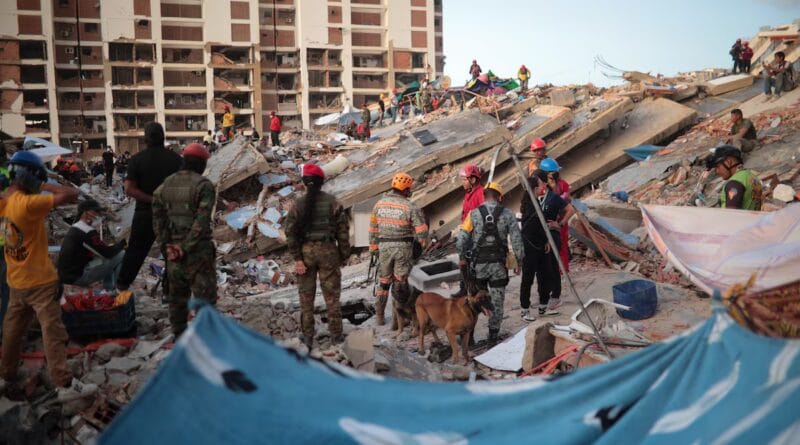
JUST IN: The cost of reconstruction after the earthquakes could greatly exceed 37 billion dollars, in an economy without financial or institutional muscle to face it: The earthquakes impact economic reconstruction plans in Venezuela
World News Update:
Governments, analysts, and media outlets are continuing to follow this situation closely as additional details become available.
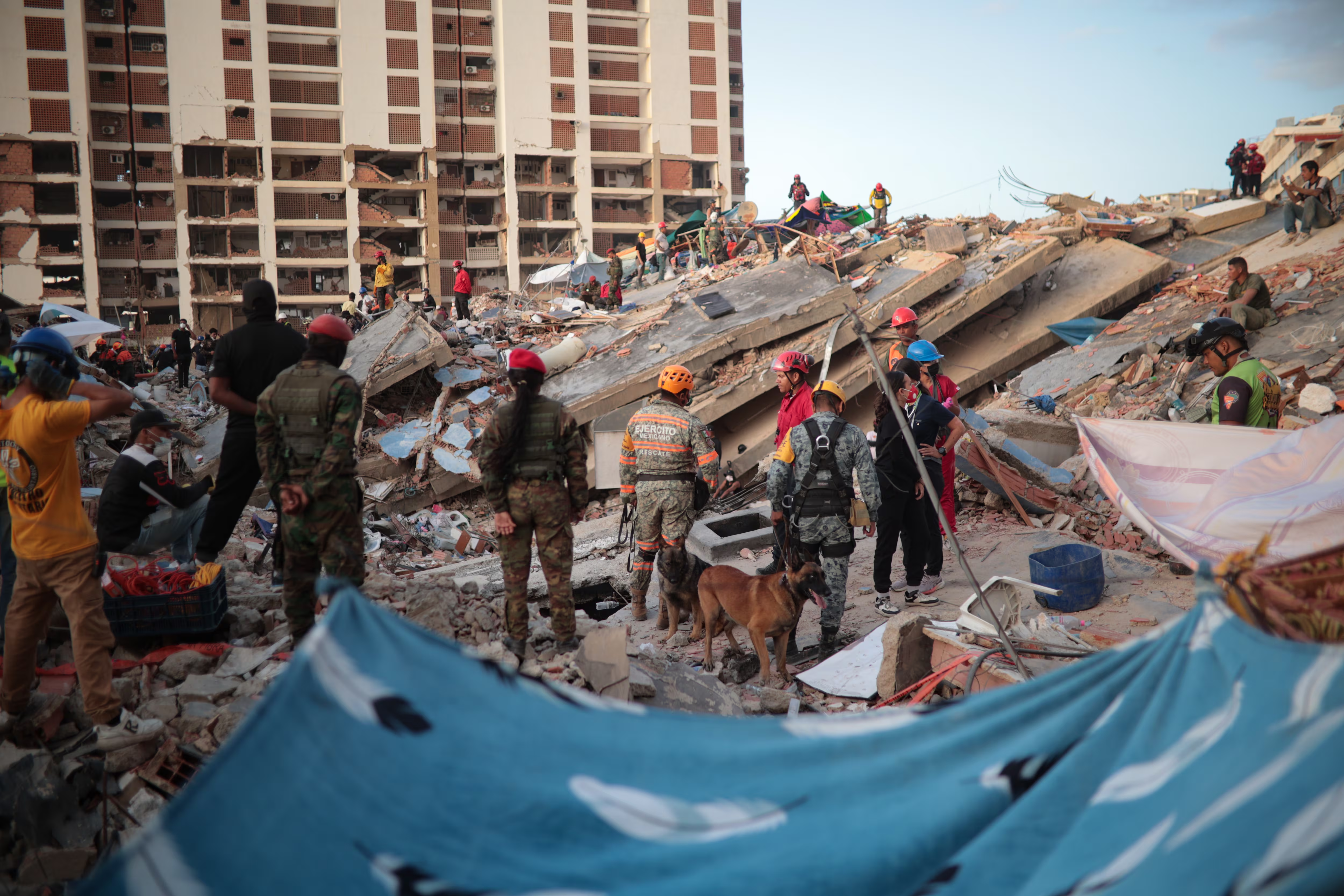
The devastating earthquakes that hit Venezuela have also exposed the broken foundations of its economy. Beyond the profound social and community damage, the country will also have to face a bill that could easily exceed $37 billion, at a time when it lacks the financial, institutional and human muscle to face it. The available figures barely outline the magnitude of the challenge: the United Nations Office for Disaster Risk Reduction (UNDRR) estimates that damage to residential, commercial or educational buildings is equivalent to 24 billion dollars, while the impact on water, telecommunications, roads, energy, ports, airports, oil and gas infrastructure reaches 13 billion dollars. But if the indirect losses, the interruption of productive and service activity, the delay of investments and the deterioration of key infrastructures are incorporated, the total cost of reconstruction could far exceed that estimate. The consequences of the natural disaster – equally imponderable emotionally – are aggravated after years of high inflation, shortages, flight of talent and wear and tear of the State, which has lost basic functions, such as guaranteeing legal and physical security, creating a business climate and attracting capital that will be critical in the next phase of the disaster. What is at stake is no small matter: sustaining the momentum in vital sectors such as oil, housing, roads, telecommunications and electricity. Also, provide support to small and medium-sized businesses and businesses, in a framework where it is estimated that up to 80% of workers operate on their own and live from day to day. Belongings recovered in La Guaira, on June 28. Chelo CamachoAs in other contingencies, oil recovery will be fundamental, as it remains the main source of income. According to the state-owned Petróleos de Venezuela (PDVSA), its extensive infrastructure was not impacted by the seismic doublet, which has caused 3,685 deaths, 16,740 injuries and 17,907 people without housing, according to the latest official count, in addition to hundreds of damaged buildings. However, the pace of exports slowed slightly, to 1.2 million barrels per day in June compared to 1.24 million barrels in May, due to delays at shipping terminals caused by the earthquakes, according to data reviewed by Reuters. In an example of the regular accident rate to which the oil company is exposed, the agency also reports that, in just the week after the earthquakes, the Amuay refinery, the main one in the circuit, was stopped due to an electrical failure, while a drilling rig exploded in the central area, injuring 17 workers. “Current operations and exports have not stopped due to the earthquakes,” summarizes Armando Arteaga, oil and gas lawyer. “But it is difficult to give security to a company – whatever it may be, an Exxon or Conoco or Chevron – that assumes that Venezuelan courts can resolve disputes, that commercial registries can offer information to carry out due diligence or that it will be able to apply consistent tax criteria. If that was already under pressure before June 24, now that pressure is multiplied,” adds the advisor specialized in companies with an interest in exploiting the vast reserves of the Caribbean country. The production of local crude oil, as well as its price in the market, have been recovering since the United States military intervention in Caracas, the arrest of President Nicolás Maduro and the beginning of an unprecedented role of the Donald Trump Administration in Venezuelan political and financial tutelage. Pumping has grown by 28% from January to May, according to figures from the Organization of Petroleum Exporting Countries (OPEC), driven by new agreements to reactivate the industry, such as the agreement with Shell to develop a gas field or the one signed with the services firm SLB to modernize operations in mature fields. Added to this are the pacts with Chevron and the Spanish company Repsol, in a bid to attract foreign investment. Health personnel search for requested medicines La Guaira (Venezuela). Daniel Echeverría “Oil will continue to flow. The question is whether the institutions that must support the entire structure, the contracts, protect the investment and manage the income, can operate at the same pace as the trade agreements they assume. We do not know that,” adds the advisor. Flight of necessary talents In parallel, the country is preparing to face a monumental refinancing of its external debt, in default since 2017. The figure could rise to up to 240,000 million dollars, as published by the Financial Times; more than double last year’s GDP, estimated at $110 billion, according to the International Monetary Fund (IMF). According to the IMF, the South American economy has shrunk to a quarter of its size since its 2012 peak, driven by an oil boom that a few years later gave way to one of the worst crashes in the modern history of the country and the continent. This collapse has pushed at least eight million Venezuelans into migration or exile, among them highly qualified professionals and technicians. “The earthquake makes the economic cost of this talent drain even more evident,” wrote economist Asdrúbal Oliveros in an analysis of the reconstruction, in which he poses a central question: “Who is going to execute it?” The South American nation will face an extraordinary demand for professionals from engineers and architects, to health personnel or managers, to mental health professionals and builders. The precariousness of the rescues in the central area of the disaster, the coastal state of La Guaira, showed that the country, in addition to lacking the technical capacity to react to calamities, also lacks such basic things as fuel or medical supplies. The recomposition will require attracting human capital, but also opening spaces for the diaspora to contribute with their knowledge, in a situation where talent becomes an asset as valuable as international financing. Given so many accumulated needs, another question arises: how much of the bill will be paid by the United States, today the main administrator of Venezuela’s resources. The State Department has increased its aid commitment to more than 300 million dollars, while the Government of Venezuela has announced a fund of 200 million and support for merchants and businessmen, focused on immediate attention to the disaster. In the four months since the United States took control of oil exports, almost 100 million barrels of crude oil, equivalent to about 8 billion dollars, have passed through that mechanism, according to the Council on Foreign Relations (CFR). English). “Although the Trump administration has repeatedly presented this control as beneficial for both countries, it has not publicly revealed how much Venezuelan oil it has sold, how much revenue it has collected, or how it has used those funds,” the analysis highlights. The lack of transparency thus adds to the opacity that has characterized the country for years, closing the margin to anticipate its economic course and how it will assume the cost of reconstruction in line with the needs of the population. “Rebuilding a country is not only about building bridges, roads or homes. It also involves rebuilding capabilities, institutions and trust,” adds Oliveros.
What Happens Next:
Analysts believe this development may influence future diplomatic, political, or economic discussions internationally.
Political and economic analysts are paying close attention to the potential consequences of these events.
Follow our coverage for more global news and international analysis.
Source: This article was originally published by Internacional en EL PAÍS and adapted for our international English-speaking audience.
Read the original article here.