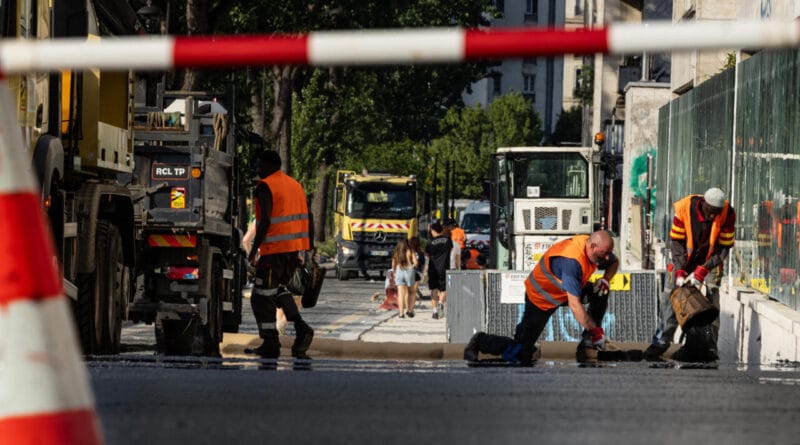
LATEST: “I try to hold on, day after day”: these workers on the front line facing the heatwave
World News Update:
International observers are closely monitoring the latest developments as new information continues to emerge.
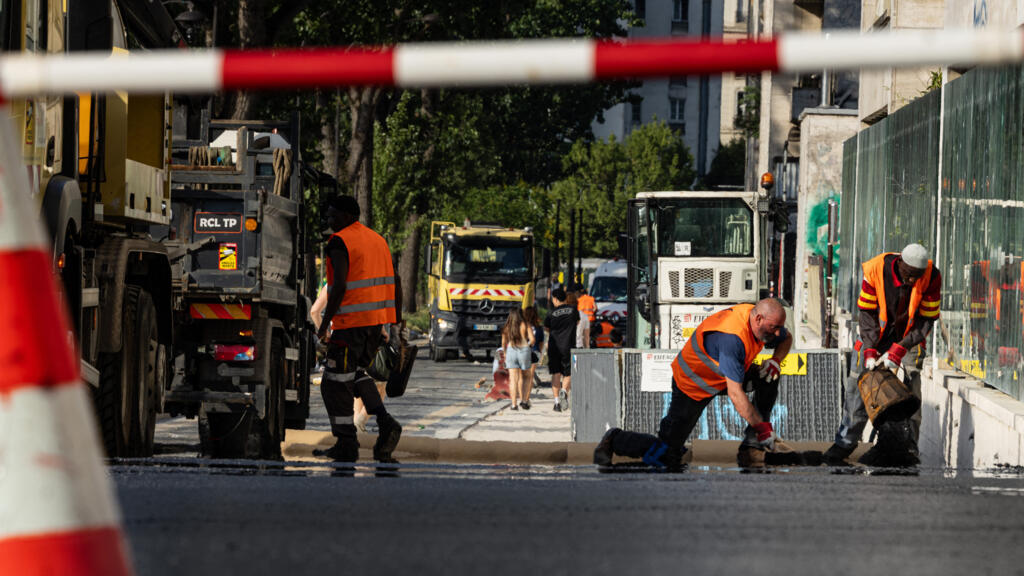
It’s not yet 11 a.m. and the thermometer is already close to 30°C. In the heart of Paris, in the Châtelet district, the decor is unrecognizable. The hubbub and the continuous flow of passers-by gave way to an almost unreal calm. The terraces are empty, the overheated sidewalks are deserted and the rare figures who venture there are desperately looking for a corner of shade. In this city which seems to be slowing down, Abdelkrim nevertheless continues his tour. Broom in hand, this sixty-year-old cleaner advances under the blazing sun. After several hours spent outside, he takes a short break away from the sun’s rays before catching his breath. “We started at 5 a.m. to get as far as possible before the temperatures got even higher,” he explains. “Today, they should reach 37°C. The more the hours pass, the more difficult and grueling the work becomes.” Abdelkrim, cleaning agent in Paris, June 23, 2026. © Hamza Habhoub, France 24 An increasingly monitored occupational risk While some take refuge in air-conditioned offices or leave the capital to escape the heat, thousands of workers remain on the front line. For them, heatwaves are not a simple summer discomfort, but a daily constraint that puts their health and safety to the test. This reality is now recognized by the authorities. In an instruction signed on May 22, the Ministry of Labor recalls that “increasingly recurrent and intense” heat episodes must be fully integrated into “professional risk assessment and prevention approaches”. The document highlights an increase in discomfort, loss of alertness and accidents linked to the use of machines, pushing public authorities to strengthen prevention measures during episodes of extreme heat. See also Heatwave: how workers adapt to extreme heat The Regional Directorate of Economy, Employment, Labor and Solidarity (Dreets) of Île-de-France also recalls that, since July 2025, employers have had the obligation to make fresh water available to employees, to adjust schedules when possible and to reduce exposure to the sun during the hottest hours. Health authorities also warn of the consequences of prolonged exposure to heat. Headaches, dehydration, exhaustion, even heat stroke: the risks are multiple and can quickly become serious. “I have no choice” To escape the highest temperatures, many now start their day before dawn. But these advanced schedules are not always enough to mitigate the effects of heat that sets in for a long time. On the Avenue des Champs-Élysées, Safiullah is busy among the plants he takes care of for a restaurant. Under heavy, humid heat, this Afghan gardener goes back and forth with his watering can, while trying to conserve his strength. Safiullah, gardener for a Parisian restaurant, June 23, 2026. © Hamza Habhoub, France 24 “I sweat a lot and I feel tired all the time,” he confides, wiping his forehead. “But I have no choice. My situation forces me to continue working whatever the conditions. I just try to keep going, day after day.” On a construction site where concrete and metal structures radiate heat, Alexandre makes the same observation. “The heat is extremely strong and the work sometimes becomes almost unbearable,” explains this Georgian worker. We try to cool off by splashing ourselves with water and we start at 6 a.m. to take advantage of the relative coolness of the early hours. But in the end, we have no other choice but to continue.” According to the union organizations, these situations are likely to repeat themselves. In a press release published on Sunday June 21, the General Confederation of Labor (CGT) recalls that in 2024, 11 work accidents probably linked to heat were recorded in the country by the General Directorate of Labor (DGT), including 7 fatal. The union, which calls for strengthening protections for the most exposed employees, underlines that heat waves “are no longer exceptional” but are expected to repeat themselves and intensify “over an increasingly long period, from May to October.” Also read: Work under heatwave: should we establish a “climate holiday”? As the mercury rises, pressure also increases in health establishments. 2 out of 4. “This decision will make it possible to strengthen medical regulation capacities, to mobilize the personnel necessary for the operation of the hospital, to guarantee full coordination between community medicine, hospitals, clinics and nursing homes, and to adapt activities if the situation requires it”, detailed the Prime Minister on the social network air conditioners, fans and misting devices have also been set up or reinforced to accommodate the most vulnerable patients. See also Reception conditions deteriorated in hospitals due to the heatwave The Assistance publique-Hôpitaux de Paris (AP-HP) also ensures that maximum vigilance is maintained in the emergency services and the four SAMUs in the Ile-de-France region. certain chronic pathologies. The capacities of the intensive care units and the number of beds available are also monitored daily. The first effects of this heatwave are already being felt. According to data communicated by the institution to France 24, emergency attendance has increased since the start of the week. During the Music Festival, admissions reached an exceptional level, almost twice as high as normal. more than 30% compared to the previous week, while medical regulation files increased by 22% in one week “When I feel suffocated, I look for a cool place” In a quiet street in Paris, Youssef continues his tour as a cleaning agent, he takes a few minutes in the shade to regain his strength. Summer vacation is approaching. I try to take regular breaks. When I can, I sit in a café or an air-conditioned place to recover a little. I also drink a lot of cold drinks to keep me going until the end of the day.” Also readNew heatwave in France: “The temperatures will go back down and we won’t talk about it anymore” Across the street, Paul painfully pushes his mail cart. The postman moves at a slower pace than usual. A bottle of water and a damp towel accompany him throughout his tour. “It would be useful to provide more portable fans or cooling solutions, as well as bicycles better suited to episodes of high heat”, he believes. Delivery drivers are also among the most exposed workers. In the 2nd arrondissement, Ahmed waits for a new order in front of a restaurant, at the foot of his bicycle. The thirty-year-old Ivorian makes deliveries from morning until late in the evening. Ahmed, Ivorian delivery man, in Paris, June 23, 2026. © Hamza Habhoub, France 24 “I work from 9 a.m. until midnight. I have no choice,” he says, his face marked by fatigue. “I don’t have a residence permit and my family depends on me. If I stop working, I risk ending up on the street.” When the heat becomes too difficult to bear, Ahmed takes short breaks out of the sun. “Sometimes I feel like I’m suffocating. So, I look for a cool, shaded place before leaving. I don’t want to experience what happened to some of my friends, who ended up in the emergency room.” This article was adapted from Arabic. The original version is available here.
International Perspective:
The situation could have broader implications for regional stability, international relations, and global markets.
Additional reactions from governments and international institutions are expected as the situation evolves.
Stay tuned for further updates on this developing international story.
Source: This article was originally published by France 24 – Infos, news & actualités – L'information internationale en direct and adapted for our international English-speaking audience.
Read the original article here.